

Selling a business is not a single event. It’s a sequence — valuation, positioning, buyer outreach, negotiation, financing, and closing — and each phase has real financial consequences. Owners who understand the sequence in advance move through it with far more confidence than those who are figuring it out step by step under pressure.
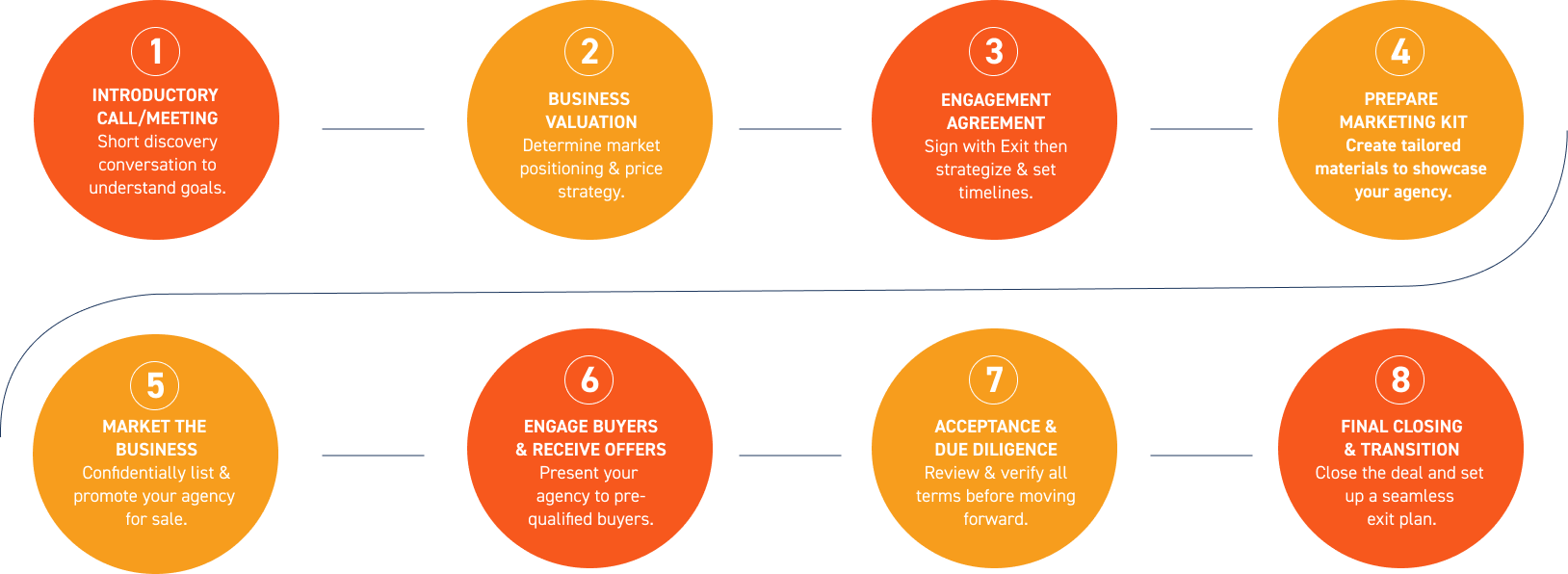
This is what the process typically looks like when an agency goes to market with professional representation, along with realistic timelines for each phase based on current M&A market activity.
1. Introductory Call or Meeting
The process starts with a conversation, not a commitment. A broker learns the owner’s goals, timeline, and what a successful exit actually looks like for them — financially and personally. Plan on roughly an hour for this first discussion.
2. Business Valuation
Next comes an honest look at what the agency is worth today, based on cash flow, deal structure norms, and current market demand. This can start with a fast, no-cost Quick Look Valuation (roughly a one-week turnaround) or move directly into a Comprehensive Valuation for owners who are ready to go to market, which takes longer because it involves deeper documentation.
3. Engagement Agreement
If the owner decides to move forward, they engage the broker as their exclusive representative. This is typically a standard agreement finalized within a day, formalizing the relationship and the terms of representation.
4. Prepare the Marketing Kit
The broker packages the business into a “Confidential Information Memorandum” (CIM): clear, credible story that buyers can seize and bankers can underwrite — financials, add-back documentation, growth narrative, and positioning. In this phase too, Exit Advisors complete a tremendous amount of the due diligence that buyers and bankers will subsequently require; this speeds the subsequent process. Preparation of the CIM typically takes a couple of weeks and is usually the only fee an owner incurs before closing.
5. Market the Business
With materials ready, the opportunity goes out confidentially to a targeted pool of qualified buyers, using direct outreach, listings, and buyer-network channels. Confidentiality protocols — including NDAs — protect the agency’s employees, clients, and competitive position throughout this stage.
6. Engage Buyers and Receive Offers
The broker manages inbound interest, conversations, and offer negotiation, bringing qualified prospects to the table. Careful buyer vetting matters most here: by the time an owner meets a prospective buyer, that buyer should have already demonstrated financial capacity and genuine interest, not just curiosity.
7. Acceptance and Due Diligence Completion
Once an offer is accepted, due diligence continues and deepens. This is where lenders, accountants, and the buyer’s own advisors dig into financial and operational details. The broker’s job during this phase is to keep momentum, manage document requests, and troubleshoot issues before they become deal-breakers.
8. Final Closing and Transition
The last stage coordinates attorneys, lenders, accountants, and the buyer to formally close the transaction and manage a clean operational transition. This includes client and employee communication planning — a step that, handled poorly, can undermine the very stability a buyer just paid for.
Realistic Timelines by Phase
| Phase | Typical Duration |
|---|---|
| Valuation (Quick Look) | Approximately 1 week |
| Valuation (Comprehensive) | 2–4 weeks, depending on the availability and completeness of documentation |
| Marketing Kit Preparation | 2–3 weeks |
| Marketing and Buyer Outreach | 3–10 months, depending on buyer interest, market conditions, and business complexity |
| Due Diligence (Smaller Agency) | 2–4 weeks from signed Letter of Intent (LOI) or Purchase Agreement |
| Due Diligence (Lower Middle-Market Business) | 2–4 weeks from signed Letter of Intent (LOI) or Purchase Agreement |
| Total Process: Engagement to Closing | 6–12 months |
Deals with clean financials, low client concentration, and realistic seller expectations tend to land at the faster end of these ranges. Deals with disorganized books, unresolved owner-dependence issues, or an unprepared seller tend to stretch toward the longer end — or stall entirely.
What Buyers and Lenders Are Checking Along the Way
Two audiences are evaluating the business simultaneously throughout this process: the buyer and, in most transactions, an SBA or conventional lender financing the purchase.
Lenders in particular are underwriting risk, not just reviewing numbers. They want to see clean, verifiable financials; consistent cash flow rather than volatile project spikes; and no single client representing an outsized share of revenue — generally no more than 10%. They also weigh how dependent the business is on the current owner for sales or delivery, since that uncertainty affects whether the business will perform through a transition.
Since most buyers in the lower middle market rely on financing, and SBA-backed loans are the most common path, an agency’s ability to qualify for that financing directly shapes the size and quality of its buyer pool. An agency that qualifies opens the door to more capable, motivated buyers — which creates the competitive tension that improves price and terms.
Why Deals Stall — and How to Avoid It
Deals rarely fail for one dramatic reason. They usually stall from an accumulation of small frictions: financials that take too long to explain, a key client relationship that makes a buyer nervous, or an owner who hasn’t mentally let go of day-to-day decisions, still does all the sales and holds the client relationships.
The owners who move through this process most smoothly are the ones who started preparing before they had to — cleaning up financials, reducing client concentration, and building a leadership layer that doesn’t depend entirely on them. That preparation doesn’t just make the business easier to sell. It tends to make it a better business to run in the meantime.
Who Manages the Process
Behind each of these eight steps sits a lot of coordination: buyers, lenders, attorneys, accountants, and a rotating set of deadlines. In a broker-managed sale, the broker acts as the quarterback for all of it — keeping the process organized and moving even when several moving parts are in motion at once. Don’t underestimate the time this takes the broker. It’s very common for a broker to spend a hundred hours or more on a single small to mid-market deal.
That role matters more than it might seem. An owner who is also running daily operations rarely has the bandwidth to manage buyer outreach, negotiate offers, and track diligence requests simultaneously. Deals that lack a dedicated point person are far more likely to lose momentum between stages, and lost momentum is one of the most common reasons an otherwise good deal never reaches closing.
Frequently Asked Questions
The process generally includes an introductory call, business valuation, engagement agreement, marketing kit preparation, marketing the business to buyers, buyer engagement and offers, due diligence, and final closing — eight stages in total.
A well-run sale typically takes six to twelve months from initial engagement to closing, though smaller, well-prepared deals can move faster and complex deals can take longer.
For a smaller, owner-operated agency, expect roughly two to four weeks from a signed letter of intent to closing. Larger lower middle-market deals typically take longer.
A Quick Look Valuation is a fast, no-cost preliminary valuation based on the most recent three years of financials, typically delivered within about a week. It establishes a realistic value range before an owner commits to a full sale process.
Common causes include disorganized or unverifiable financials, high client concentration, excessive owner dependence, unqualified buyers, lease issues and financing that falls through during due diligence.
Most owners who achieve the strongest outcomes start preparing 12 to 36 months before they intend to sell, giving them time to address financial clarity, client concentration, and owner dependence before going to market. However, we sell agencies that did not prepare in advance; the downside is that they usually go on the market at a lower valuation and sale price.
The Bottom Line
Selling a marketing agency is a defined sequence, not a single transaction — and every phase, from valuation through closing, builds on the one before it. Owners who understand the process in advance, and who start preparing well before they need to, consistently move through it with more confidence, fewer surprises, and stronger outcomes.
If you’re considering a sale in the next few years, starting with a confidential conversation and a no-cost valuation range is a low-pressure way to see where you stand today. Exit M+A’s Coach To Sell consultation is a smart framework to help you prepare the way.